Short answer
Dropshipping is a retail model where you sell products online without holding any stock. A customer buys from your store, you forward the order to a supplier, and the supplier ships the product directly to that customer. You never touch the product. Your profit is the gap between your retail price and the supplier's price, minus platform fees, payment fees, shipping, advertising and refunds. In 2026 it is still a real business model, but the honest version is this: most stores land at 10% to 30% net margins, beginners usually under 15%, and it only works when you treat it like a real store — with a real supplier, real customer service, and honest unit economics.
What dropshipping is — and what it is not
Dropshipping is a fulfilment method, not a business in itself. The business is still the store: choosing products, pricing them, earning traffic, and keeping customers happy. Dropshipping only changes who holds the stock and who packs the box.
It is not free money, and it is not passive income. You answer the "where is my order?" emails, handle the refunds, and pay for the ads. A supplier who ships late or sends the wrong item becomes your problem, because the customer bought from you, not from them.
It is also not the same as print on demand or private label. With print on demand, products are made to order with your design. With private label, you buy stock in bulk under your own brand. Dropshipping sits in between: you sell existing products, made and stocked by someone else, under your store's name.
How dropshipping works, step by step
The order flow is simple on paper and has more handoffs than beginners expect:
- You list the product. You import a supplier's listing into your store, rewrite the title and description in your own words, choose photos, and set your retail price. Nothing is bought yet.
- A customer checks out. They pay your price through your checkout. The money lands in your payment account, minus the card processing fee.
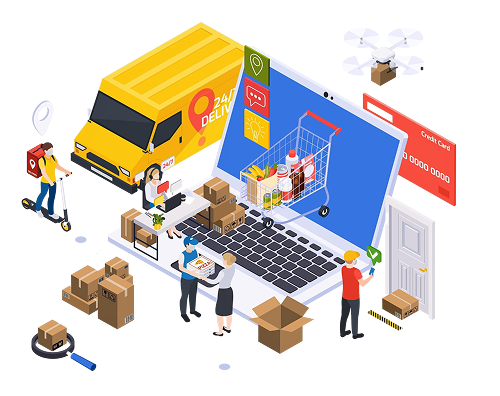
- You place the matching order with the supplier. Either by hand — opening the supplier page, entering the customer's address, and paying — or automatically through a dropshipping app. You pay the supplier's price plus shipping, usually by card.
- The supplier processes the order. Most AliExpress sellers quote one to five days of handling before the parcel leaves the warehouse. US and EU warehouse suppliers are usually faster.
- The parcel ships and a tracking number comes back. Your app, or you, adds the tracking number to the order in your store, which triggers a shipping confirmation email to the customer.
- The order is delivered. International parcels from China commonly take one to three weeks depending on the shipping method. Orders from a domestic warehouse can arrive in a few days.
- After-sales support stays with you. Delivery questions, returns, refunds and reviews are yours. The supplier does not talk to your customer.
Step three is the one people underestimate. Placing supplier orders by hand means a few minutes of copying, pasting and double-checking addresses for every sale. That is fine for your first ten orders and painful after that — which is why automation apps exist.
Is dropshipping profitable in 2026?
Yes — with the right expectations. Printful's 2026 analysis puts most dropshipping stores between 10% and 30% net margin, after product cost, shipping, platform fees and advertising, with beginners typically under 15%. Other 2026 breakdowns put typical net margins at 8% to 20% before ad spend, and one analysis of real order economics found net profit of roughly $3 to $12 per order once acquisition costs are included.
The mistake is confusing gross margin with net margin. Gross margin is your retail price minus the supplier's price. Net margin is what is left after everything: platform subscription, payment fees, app subscriptions, advertising, refunds, and chargebacks. Transaction fees, app subscriptions and ad costs commonly eat 40% to 60% of gross revenue across dropshipping models, which is why a product that looks like a 50% margin on paper can leave you with almost nothing.
A worked example, using real 2026 costs:
- You sell a product for $39.
- Supplier price plus shipping: $17. That leaves $22 gross margin.
- Shopify Payments fee (2.9% + 30¢): about $1.43.
- Advertising to win that order: $8 to $15 is a realistic cost per acquisition in 2026, with Meta ad prices up year over year.
- Net result: roughly $5 to $12 per order — before refunds, app subscriptions and your time.
That is a workable business if you sell volume or higher-ticket products, and a poor one if you chase $15 products with $12 acquisition costs. The niche matters more than the model: jewellery and accessories can support 20% to 35% margins because of low shipping costs and high perceived value, while saturated mass-market niches like phone cases are effectively unworkable at current ad prices. Higher-ticket products in the $80 to $200 range are where most surviving stores focus in 2026. The market itself is still growing: Shopify puts the dropshipping industry at $167 billion in 2026, and Grand View Research projects the global market to pass $500 billion by 2027.
The real costs of starting
Dropshipping needs little cash to start because you only pay for goods you have already sold. But "little" is not "nothing". A realistic lean budget for a Shopify-based store in 2026:
- Shopify Basic: $39 a month, or $29 a month billed annually. Grow is $105 a month ($79 annually) and Advanced is $399 a month ($299 annually). Shopify also offers a 3-day trial, then $1 a month for the first three months on most plans.
- Payment processing: 2.9% + 30¢ per online card sale on Basic with Shopify Payments. Using a third-party gateway instead adds a further 2% fee on Basic.
- Domain: roughly $10 to $15 a year.
- Dropshipping app: $27 to $60 a month. Spocket's Starter plan is $39.99 a month (25 products); its Professional plan is $59.99 a month, or $24 a month billed annually (250 products). AutoDS for Shopify starts at $26.90 a month for Import, $39.90 for Starter and $66.90 for Advanced, with automatic ordering as a $9.90-a-month add-on. AliExpress-based apps such as DSers are cheaper, and some suppliers like CJdropshipping charge no subscription at all.
- Product samples: $50 to $150. Order your own products before you sell them. This is the cheapest quality control you will ever buy.
- Test advertising: $300 to $600 you are willing to lose. Set a test budget and a rule for stopping before you spend it.
All in, plan on roughly $300 to $1,500 to start properly, with about $30 to $70 a month in fixed costs before advertising. Prices change often, so confirm them on the vendor's pricing page before you commit.
How to find dropshipping suppliers
Your supplier is your business partner, and a bad one will cost you more than any ad mistake. There are four main routes:
- Marketplaces — AliExpress and Alibaba. The biggest catalogues and the lowest prices, but the slowest shipping (one to three weeks to the US) and the most variable quality. Best for testing products cheaply.
- US and EU supplier platforms — Spocket and Zendrop. Curated suppliers with domestic warehouses, so delivery takes days instead of weeks. You pay a monthly subscription, and product prices are higher than AliExpress.
- Automation platforms — AutoDS and DSers. These connect your store to supplier catalogues, import products in bulk, sync prices and stock, and automate order forwarding. AutoDS also covers eBay, Amazon, Etsy and TikTok Shop, but each channel needs its own plan.
- Direct suppliers and agents — CJdropshipping and private agents. A sourcing agent finds factories for you, checks quality, and can hold stock or brand packaging. This is the route most serious sellers graduate to once a product proves itself.
However you source, vet the supplier before you list their products: order a sample yourself and time the delivery, check their ratings and response time, confirm they ship with plain or branded packaging and no supplier pricing in the box, and ask what happens with returns and damaged items — in writing.
A US-market note for 2026: duties have changed
If you sell into the United States, know this before you price anything: the US $800 de minimis duty exemption — the rule that let low-value parcels enter duty-free — was suspended for all countries in August 2025. Parcels from overseas suppliers can now attract duties and extra handling, and delivery times and landed costs are less predictable than they were. US and EU warehouse suppliers have become more attractive partly because of this. Check the current rules and your supplier's shipping terms before you set prices, and state delivery times honestly on your store.
Dropshipping vs Shopify: the question behind the question
People search "dropshipping vs Shopify" as if they were two options. They are not. Shopify is the store platform; dropshipping is the fulfilment method that runs on it. The real comparison is Shopify versus other platforms for running a dropshipping store.
Shopify is the default choice for most dropshippers because the app ecosystem — Spocket, AutoDS, DSers, Zendrop — is built for it, and the checkout, payments and order management work out of the box. WooCommerce is the main alternative: cheaper (the software is free, you pay for hosting), more flexible, but you assemble the pieces yourself. Etsy and Amazon are marketplaces, not your own store — they bring traffic, but you follow their rules and pay their fees.
My advice, from running my own US-market Shopify store: if you are starting from zero, start on Shopify Basic. The $29 to $39 a month buys you a platform that just works, and your time goes into products and customers instead of plugins. If you already run WordPress and know it well, WooCommerce is a legitimate second choice.
How to start dropshipping on Shopify
- Pick a niche, not a product. A niche is a group of people with a shared problem — home gym owners, new parents, hobbyist woodworkers. A single trending product is a lottery ticket; a niche gives you repeat customers and products to add later.
- Validate before you build. Check demand with Google Trends, Amazon bestsellers and TikTok search. Look for products with a clear use case, a price you can mark up at least 2 to 3 times the supplier cost, and shipping times you can defend.
- Set up the store. Shopify Basic, a clean theme, a real domain, and pages that answer the questions a sceptical buyer asks: shipping times, returns, contact details, and a privacy policy.
- Connect a supplier app. Import 10 to 20 products, not 200. Rewrite every title and description — copied AliExpress copy is how stores end up looking like scams.
- Order samples. Photograph them, test them, and fix anything wrong before a customer finds it.
- Set honest shipping expectations. If delivery takes two weeks, say two weeks. The FTC's Mail Order Rule requires you to ship within the time you state, or within 30 days if you state none.
- Launch with one traffic channel. Paid social or search, not both at once. Spend a fixed test budget per product, kill losers fast, and scale only what proves itself.
- Build the email list from day one. Abandoned cart, welcome and post-purchase flows turn one-time buyers into repeat revenue. I covered the tools for this in my AI tools article — Klaviyo is the one I recommend for Shopify stores.

Common mistakes that kill new dropshipping stores
- Selling products you have never seen. Samples are not optional. The first time you see your product should not be in a customer's complaint photo.
- Pricing on hope. If the margin cannot survive the payment fee, the ad cost and one refund in twenty orders, the product is not viable — no matter how well it trends.
- Copying supplier listings word for word. Customers can tell, Google can tell, and AI search engines will not cite a store that adds nothing.
- Hiding shipping times. A customer who waits three weeks for a parcel they expected in three days does not come back, and leaves a review on the way out.
- No customer service plan. You are the support team. Answer fast, refund gracefully when you are wrong, and track every complaint back to the supplier or product that caused it.
- Scaling a losing product. More ad spend on a product with bad unit economics just loses money faster.
- Fake reviews and inflated claims. The FTC's 2024 consumer reviews rule bans fake reviews, including AI-generated ones. Earn reviews from real buyers.
- Treating it as passive income. The stores that survive are the ones whose owners answer emails, fix listings, and test new products every week.
Dropshipping and AI search: why content matters now
One change from 2026 makes the store itself more important than ever. Shoppers increasingly discover products inside AI answers — ChatGPT, Perplexity and Google AI Overviews — rather than by clicking ten blue links. Those systems cite stores with clear product information, real FAQs, honest policies and useful content. A thin store with copied listings will not be cited; a store that answers the buyer's actual questions will be. I covered exactly how to get cited in my GEO article, "GEO in 2026: How to Get Cited by ChatGPT, Perplexity and Google AI Overviews" — the same short-answer boxes, clear headings and FAQ structure I use in this article are part of that playbook. And the AI tools that help you run the store once it is live — Sidekick, Klaviyo, Gorgias, Triple Whale — are the subject of my article "AI Tools for Shopify Stores in 2026: The Lean Stack That Actually Saves Time". The three articles work as a set: get found, get the tools right, and run the fulfilment model properly.
Frequently asked questions
What is dropshipping in simple terms?
You sell a product on your store without stocking it. When a customer orders, you buy it from a supplier who ships it straight to them. You keep the difference between your price and the supplier's price, minus your costs.
Is dropshipping profitable?
It can be. Most stores land at 10% to 30% net margins in 2026, with beginners typically under 15%. Profitability depends on the niche, the product's margin after advertising, and how well you manage suppliers and refunds — not on the model itself.
How much money do I need to start dropshipping?
Realistically, $300 to $1,500: a Shopify plan ($29 to $39 a month), a domain, a supplier app ($27 to $60 a month), samples, and a test ad budget you can afford to lose.
Is dropshipping legal?
Yes, it is a legal retail model. You still need to follow the rules: register your business and handle taxes properly, state shipping times honestly, honour refunds, avoid counterfeit or trademark-infringing products, and do not use fake reviews.
How long does dropshipping delivery take?
It depends on the supplier. US and EU warehouse suppliers typically deliver in a few days. AliExpress and other China-based suppliers commonly take one to three weeks, plus handling time of one to five days. Always state the real timeframe on your store.
Dropshipping vs Shopify — which should I choose?
They are not alternatives. Shopify is the platform and dropshipping is the fulfilment method. Most beginners run dropshipping on Shopify because the apps and checkout are built for it, starting on the Basic plan.
Conclusion
Dropshipping in 2026 is a real business model with thin margins and no shortcuts. The people who make it work do unglamorous things well: they pick a niche instead of chasing trends, they order samples, they price with the ad cost included, they answer customers fast, and they move winning products toward faster suppliers and their own branding.
I have spent about six years in e-commerce and around fifteen years online in total, starting as a web designer before building my own US-market Shopify store. Since I started my online career, I have earned over $100,000 in total online career earnings — not from one store or one model, but from the whole body of work. Dropshipping was one part of learning how online selling actually works: that the margin is made in the details, and that the store that tells the truth about shipping times and stands behind its orders is the one customers come back to.
If you are starting, start small, start honestly, and measure everything. The model will not make you rich by itself — but run properly, it is one of the cheapest ways to learn e-commerce with real customers and real money on the line.
Sources
- Shopify, "What Is Dropshipping and How Does It Work? (2026)" — the dropshipping model, order flow, and the $167 billion industry figure for 2026. https://www.shopify.com/blog/what-is-dropshipping
- Spocket, "What Is Dropshipping & How It Works? (2026 Guide)" — order flow, costs, and margins in 2026. https://www.spocket.co/blogs/what-is-dropshipping-and-how-it-works
- AliDrop, "How Does Dropshipping Work? Beginner Guide 2026" — step-by-step order flow, handling times, and the August 2025 de minimis change. https://www.alidrop.co/blogs/how-does-dropshipping-work
- Printful, "How profitable is dropshipping in 2026?" — most stores at 10% to 30% net margins, beginners typically under 15%. https://www.printful.com/blog/how-profitable-is-dropshipping
- Atlas Marketing, "Shopify Dropshipping in 2026: Is It Still Worth It?" — typical net margins of 8% to 20%, net profit of $3 to $12 per order, and the global market projected past $500 billion by 2027. https://www.atlasmktg.us/blog/shopify-dropshipping-2026-is-it-worth-it
- Dropshipping Champions, "Shopify Pricing 2026" — Basic $39 a month or $29 billed annually, Shopify Payments 2.9% + 30¢, third-party gateway fee 2% on Basic. https://dropshippingchampions.com/blog/shopify-pricing
- Easync, "Spocket Review 2026" — Starter $39.99 a month, Professional $59.99 a month or $24 billed annually, checked against Spocket's official pricing page in November 2026. https://easync.io/articles/spocket-review/
- Retail Presse / Debutify, "AutoDS Review 2026" — Shopify plans from $26.90 a month (Import) to $66.90 (Advanced), auto-ordering add-on $9.90 a month. https://retailpresso.com/reviews/autods-review
- Agent Hustles, "Dropshipping store with AI copy: 2026 Guide" — Shopify costs, FTC 30-day shipping rule, and the fake-review ban. https://www.agenthustles.com/h/dropshipping-store-with-ai-copy/
- Jerry Fulfillment, "Shopify Dropshipping in 2026" — US $800 de minimis exemption suspended in August 2025. https://jerryfulfillment.com/shopify-dropshipping-in-2026-how-it-works-what-it-costs-and-how-to-start/
Prices, fees and platform terms were checked against vendor and review sources in November 2026 and change often — confirm with the vendor before buying. The earnings figure in this article is over $100,000 in total online career earnings since the author started his online career, not Shopify store revenue alone.